

Let me tell you the version of this review you won't find on the product listing page. The Black Diamond Spot 400 is a genuinely good headlamp. I own one, I use it, and I recommend it to people who ask. But there are a few things about it that catch first-time buyers off guard, and if those things matter to you, they're worth knowing before you make the purchase. Specifically: the interface has a learning curve that isn't obvious, the light ships on AAA batteries and not the rechargeable BD 1500 pack you might assume comes in the box, and the PowerTap dimming system that Black Diamond advertises as a feature can feel genuinely confusing until you've used it a few times. This review is about all of that, plus what the Spot 400 gets right once you've worked through the friction.
I'm Marcus Hale. I've been backpacking in the Pacific Northwest and car camping with my family for about eleven years. I've gone through headlamps the way some people go through phone cases: trying the cheap ones, getting burned, upgrading, repeating. The Black Diamond Spot 400 is the light I landed on after that cycle, and I've used it across enough varied conditions to give you an honest picture.
The Quick Verdict
A top-tier camping headlamp with real brightness and solid waterproofing, held back only by a mode-switching interface that takes several trips to feel natural and an out-of-box charging setup that requires a separate purchase.
Amazon Check Today's Price →If you already know you want the Spot 400, skip ahead and check current pricing on Amazon.
The Spot 400 is one of the more popular headlamps in Black Diamond's lineup, which means price and availability shift. Worth checking before your next trip rolls around.
Amazon Check Today's Price on Amazon →The Thing Nobody Mentions: What's Actually in the Box
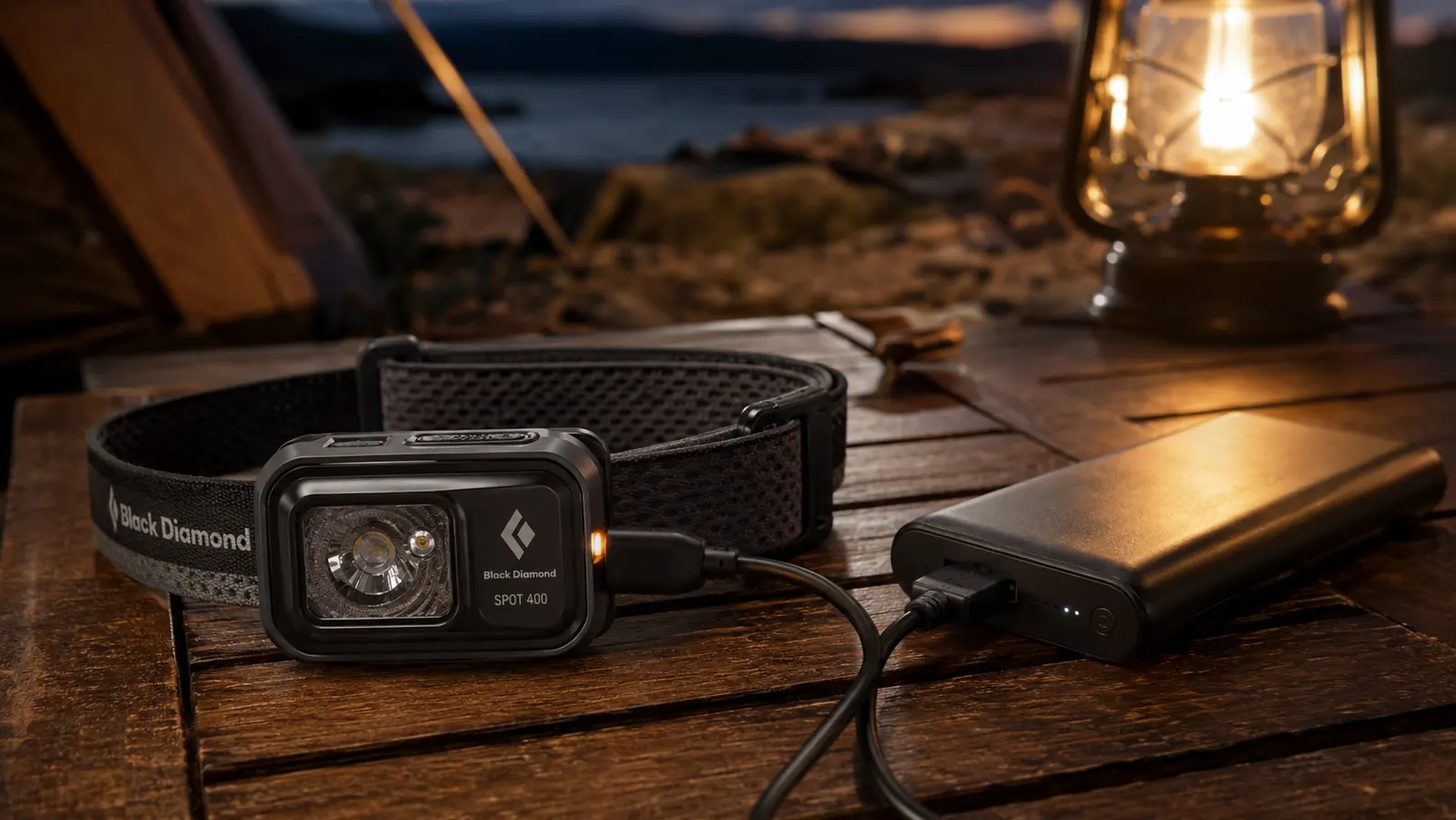
Here is the part that trips people up most often. Black Diamond markets the Spot 400 as a USB-C rechargeable headlamp, and it is. But it does not ship with the rechargeable battery pack installed. What you get in the box is the headlamp unit, the headband, and three AAA batteries already loaded in the battery tray. The USB-C rechargeable option requires Black Diamond's BD 1500 Rechargeable Battery Pack, which is sold separately. It is a purpose-built cylindrical cell that slides into the same tray where the AAA batteries sit, and it's the piece that makes USB-C charging possible.
So if you buy the Spot 400 and expect to charge it via USB-C the night you get it, you will be disappointed. You will be running on AAA batteries until you also order the BD 1500 pack. That pack typically runs in the low-to-mid range extra, which means the real entry cost for a fully rechargeable setup is higher than the base headlamp price. None of this is hidden, exactly, but Black Diamond's product page leads with the rechargeable capability without making it obvious that the enabling hardware is a separate line item. I'd rather you know before you order.
For what it's worth, the AAA battery tray isn't a bad backup. Three AAA batteries are easy to source anywhere, they work fine as a field fallback, and the headlamp performs at full spec on them. But if the rechargeable design is your reason for buying this light over a cheaper option, factor in the BD 1500 pack from the start.
The Interface Learning Curve: PowerTap, Mode Cycling, and the Lock That Isn't Obvious
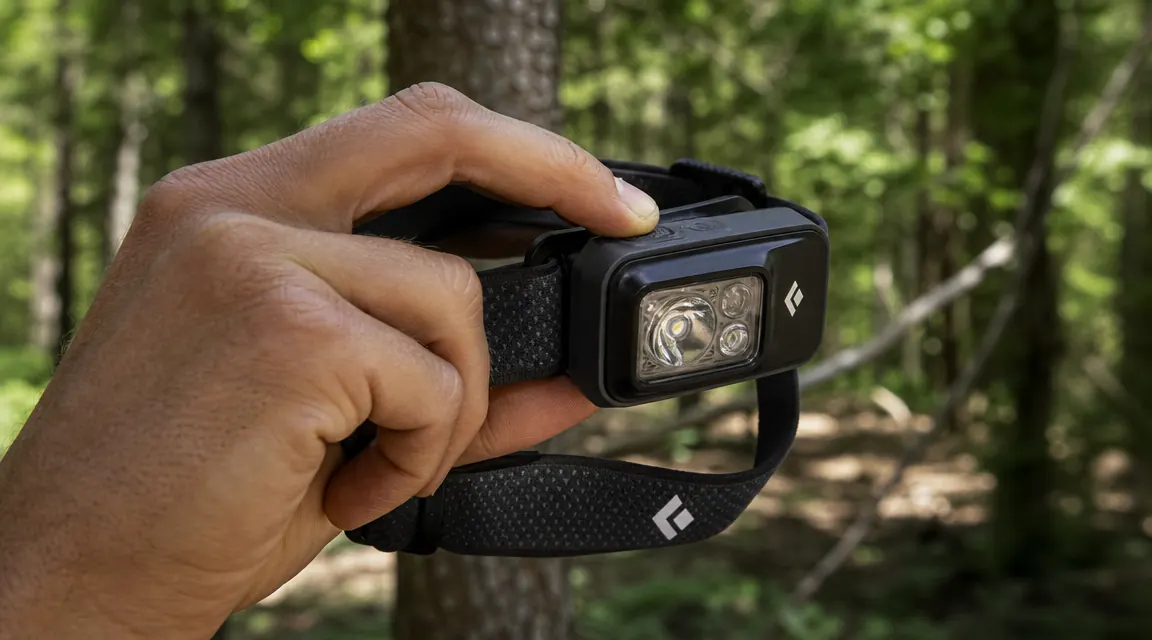
The Spot 400 has two buttons. The front button cycles through brightness modes. The rear button is the PowerTap control, which dims the light when you hold it down. On paper, simple. In the field at 9 PM when you have just crawled into your tent and you want to switch from flood to red night-vision mode, it is less intuitive than it sounds.
Here is the actual mode sequence for the Spot 400: click the front button once and the light comes on in full power. Click again and you get strobe. Click again and you get dimmed flood. Click again and you get red. Click again and you're back to full power. That means red night-vision mode is three clicks from on, not one. This bothered me for the first few outings because I kept overshooting it and waking up whoever was in my tent with an accidental strobe. The fix was to memorize the sequence. After four or five trips, I stopped thinking about it. But the learning curve is real.
The PowerTap rear button is the dimming mechanism, and it works by holding: press and hold and the light ramps from full brightness down to the minimum, then ramps back up if you keep holding. Release when you hit the level you want. This is genuinely useful for fine-tuning brightness in a tent without blinding anyone, but it takes a few sessions before it feels natural. New users often describe accidentally cycling all the way down to minimum or toggling the lock when they meant to dim. Give it two or three trips and it clicks into muscle memory.
The lockout feature, which keeps the headlamp from accidentally switching on inside your pack, is activated by holding the front button for about four seconds until the light blinks three times. To unlock, same gesture. It's reliable once you know the gesture, but I've talked to more than a few campers who couldn't figure out why their headlamp wouldn't turn on, only to discover it was locked and they didn't know they'd activated it. Worth running through the lockout procedure at home before you head out.
I've talked to campers who couldn't figure out why their headlamp wouldn't turn on. It was locked and they had no idea they'd activated it. Learn the lockout gesture at home before you need it at camp.
Once You Get Past the Learning Curve, Here Is What the Spot 400 Actually Delivers
The 400-lumen max output is legitimately bright. I have used it on dark, uneven trail descents where I needed to see root systems and footing clearly, and it delivered without hesitation. The beam has a strong center spot for distance and a soft flood for close-up work. On a dark trail with the light in spot mode, I can pick out reflective markers and trail blazes at 60 to 70 feet without straining. That is meaningfully better than the budget tier of lights I used before this one.
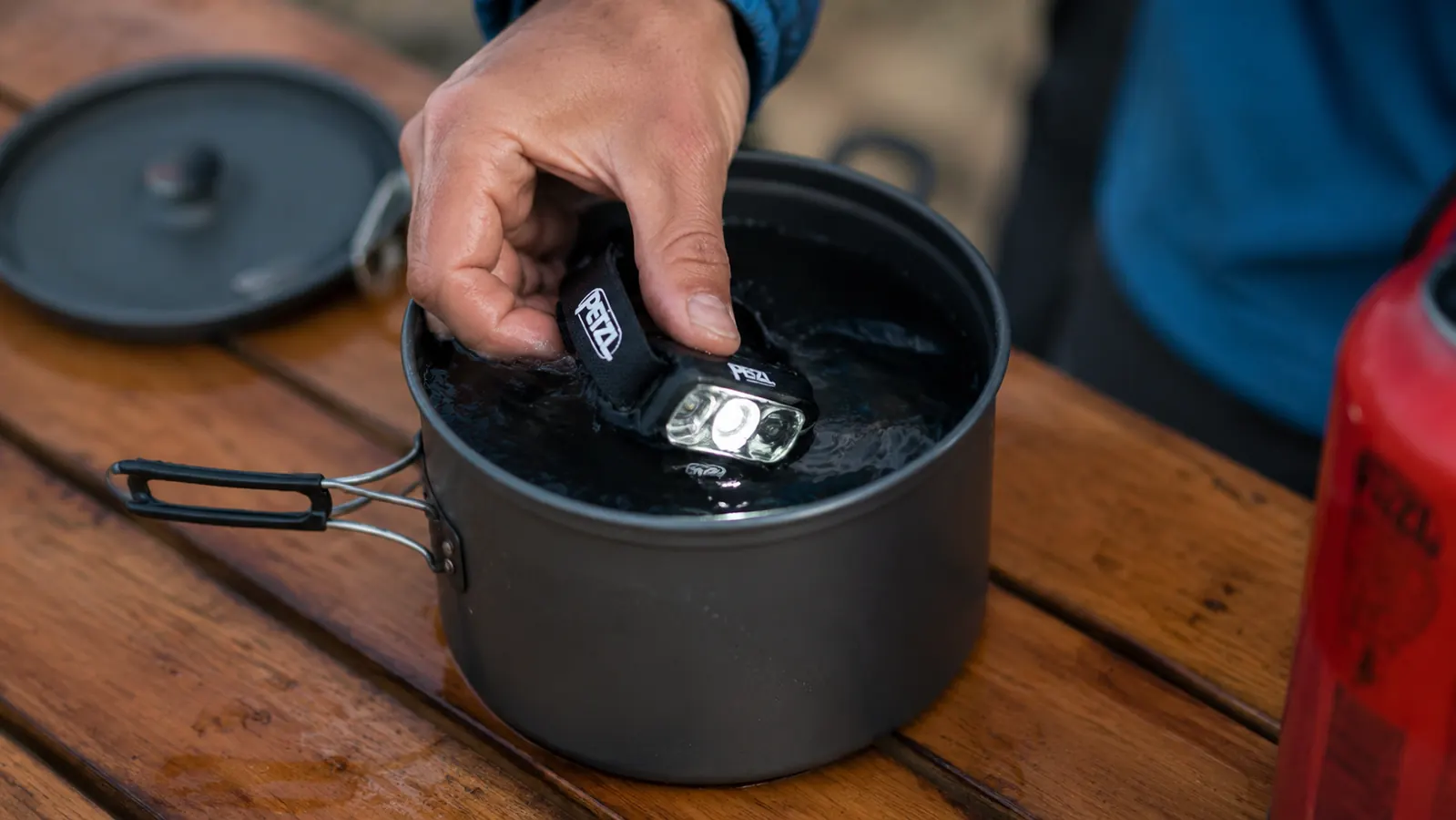
The waterproofing is rated IPX8, which means it is designed for submersion in up to about 1 meter of water for 30 minutes. In practice what that means for camping is that rain, creek splashes, and getting set down on wet gear are not concerns. I've worn this light in sustained rain for hours without any performance change. The USB-C port cover forms a tight seal when closed, and I've never had moisture intrusion issues even after outings where the headlamp spent time in a soaked pack pocket.
Weight with the battery pack installed runs about 2.6 ounces. That is not ultralight territory, but it is on the lighter side for a headlamp in this brightness and waterproofing class. I wear it for multi-hour stretches during extended camp setup without any neck fatigue, and the headband's elastic adjustment holds firmly on a wide range of head sizes without slipping down during movement.
Battery Reality: What to Expect on a Multi-Night Trip
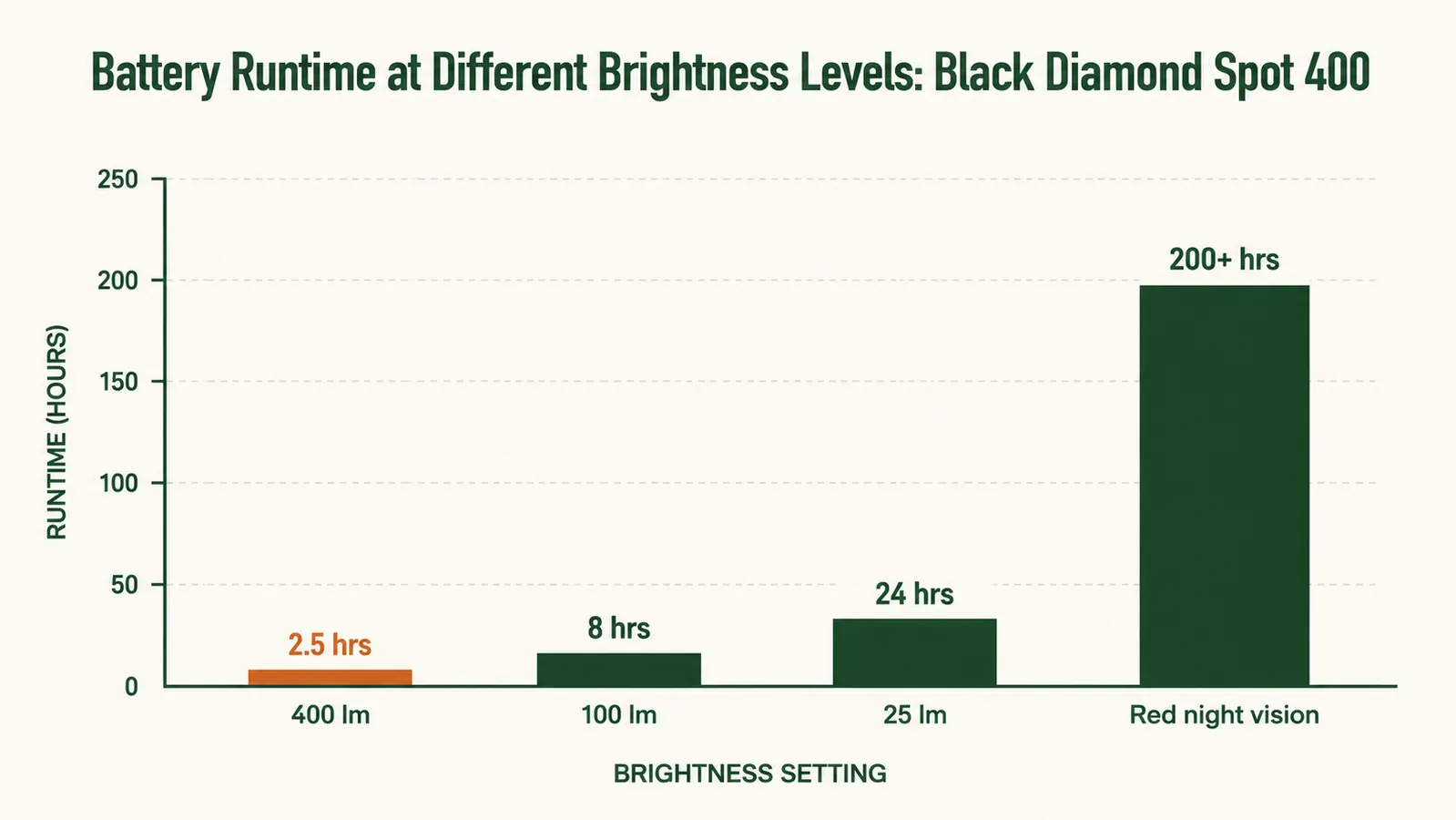
Once you have the BD 1500 rechargeable pack installed, the battery performance is genuinely good for normal camping use. On a three-night backpacking trip where I ran the headlamp for roughly 90 minutes per night, mostly at mid-brightness, I came home with charge remaining. Black Diamond's stated battery life across all modes is up to 200 hours cumulative, which is accurate for mixed usage. Running the light at full 400-lumen output the whole time will eat through that battery faster, so if you're planning extended night hiking, dropping to the mid setting saves significant runtime.
The indicator light on the back panel is a simple three-stage system: red when low, yellow when charging, green when full. Straightforward and visible even in bright daylight. One thing I appreciate is that the light does not just die when the battery is low. It dims progressively and the indicator starts blinking red well before you hit zero, giving you a warning window to either charge up or swap to AAA batteries.
The Red Night-Vision Mode: Useful, But Accessed Awkwardly
Red night-vision mode sits at 4 lumens and is accessed by cycling through the full sequence of modes from the front button. It's useful for late-night camp navigation, reading maps in a tent, or getting up in the night without disturbing a partner. At 4 lumens it's not bright enough for trail hiking, but it's more than adequate for moving around a campsite without blowing out your night adaptation.
The issue is that red mode lives at position three or four in the mode cycle depending on where you started, which means finding it in a hurry at midnight requires either muscle memory or accidentally running through strobe first. Some competing headlamps put red mode on a dedicated button or at least a shorter access path. Black Diamond chose to nest everything in one button sequence, which is clean in theory but creates that three-click navigation in practice. Once you know it, you'll stop caring. Until you know it, it's mildly annoying.
Build Quality and the One Physical Complaint
The construction of the Spot 400 is clearly above the budget tier. The housing feels dense and solid, the tilt mechanism on the light module moves precisely and holds its angle without creeping down during movement. I've had cheaper headlamps where the tilt would slowly drop over the course of a hike until the beam was pointed at the ground. The Spot 400's tilt locks with enough friction to stay put even on rough terrain.
My one physical complaint is the USB-C port cover. It's a small rubberized flap on the back of the unit that requires a fingernail or a firm thumbnail to flip open. With bare hands in moderate temperatures that's a minor inconvenience. With camp gloves or liner gloves on in cold weather, it becomes genuinely fiddly, and I've swatted at it more than once on cold mornings. Once open the port is a standard USB-C connection that charges quickly and reliably. It's just the cover that tests your patience in the cold.
What I Liked
- 400-lumen output is genuinely bright and holds up on real trails, not just marketing specs
- IPX8 waterproofing handles sustained rain and wet conditions without performance issues
- PowerTap dimming gives you smooth brightness control once you've practiced the gesture
- AAA battery tray provides a universal fallback when the rechargeable pack isn't charged
- Build quality is noticeably above the budget headlamp tier - tilt holds, housing feels solid
- Charging indicator light gives clear stage-by-stage battery status in any light condition
- Lockout mode reliably prevents accidental activation inside your pack
Where It Falls Short
- USB-C rechargeable capability requires the BD 1500 battery pack, sold separately as an additional purchase
- Mode sequence puts red night-vision three clicks from on, behind an awkward strobe step
- PowerTap dimming and lockout mechanics take several trips to feel natural
- USB-C port cover is difficult to open with gloves on in cold conditions
- At a moderate combined price for the headlamp plus the rechargeable pack, total cost is in the mid range
How It Compares to Cheaper Options
The honest answer is that cheaper headlamps work. A budget option from a reputable brand will turn on, produce light, and get you to the bathroom and back at a developed campground. Where they fall short is consistency across variable conditions: sustained rain, multi-night trips where charging mid-trip isn't an option, and situations where you genuinely need bright reliable output for navigating in the dark. If you're camping in wet climates, doing backcountry travel, or relying on a headlamp for more than casual campsite use, the gap between a budget light and the Spot 400 shows up clearly in the field.
If you want to see a direct feature-by-feature breakdown of how the Spot 400 stacks up against the Petzl Tikkina, I've put together a comparison covering lumens, waterproofing, battery type, and beam modes side by side. It's worth a look if you're deciding between the two. And if you're still building out your headlamp skills for late arrivals and dark camp setups, the guide on setting up camp after dark has a system that works even when you roll in after sunset.
Who This Is For
The Black Diamond Spot 400 is the right headlamp for campers and backpackers who go out frequently enough that gear reliability actually matters to them. If you camp five or more times a year, spend nights in wet weather, do any solo travel, or just want a headlamp you can charge alongside your phone and forget about, this light fits that need. The person who benefits most is someone who has been burned by a cheaper light at a bad moment and decided to stop playing that game. Budget for the BD 1500 pack when you order, spend one evening learning the mode sequence and lockout gesture, and this headlamp will give you no grief whatsoever in the field.
Who Should Skip It
If you camp once or twice a summer at a site with plenty of ambient light and mostly use a headlamp to find your keys or walk to the bathroom, this is more headlamp than you need. A budget option does that job fine. Similarly, if you are on a strict ultralight kit and every ounce is negotiated, there are lighter options in the 1 to 1.5 ounce range that trade waterproofing and brightness for reduced weight. The Spot 400 sits at 2.6 ounces with the rechargeable pack, which is reasonable for a headlamp in this class but not class-leading for weight. And if interface simplicity is a priority for you because you're buying this as a gift or for someone who doesn't want a learning curve, the Petzl Tikkina's more straightforward single-button operation might be a better fit.
Know the learning curve, budget for the BD 1500 pack, and the Spot 400 is hard to beat for regular campers.
It's one of the more reliable, weather-resistant headlamps in its price range. If you're going to rely on a light in variable conditions, this one earns that trust. Check current pricing and availability below.
Amazon Check Today's Price on Amazon →